Feijoo holds an MA in Fine Art Printmaking from Winchester Art
School and a BA in Illustration from Maidstone, Kent. He
solidified his technical expertise training as a master printer at
the renowned Curwen Studio before transitioning into the field of
Art education.
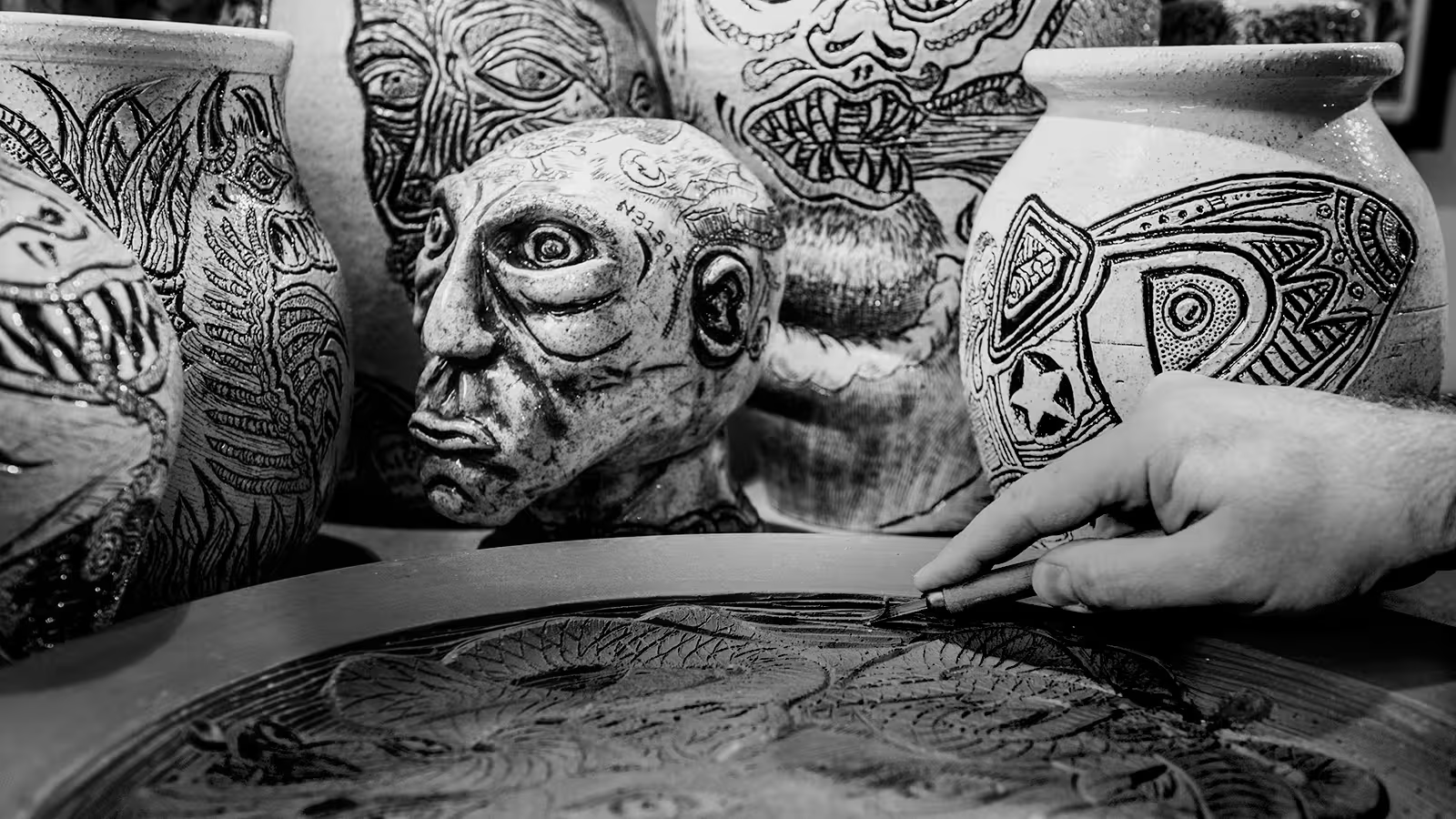
As a multi-disciplinary artist, Feijoo's practice fluidly explores
a wide range of media, creating a dialogue between printmaking,
drawing, painting, artist books, and ceramics. He has exhibited
his work internationally, winning many prestigious prizes and
awards, with his pieces acquired by numerous permanent
collections. Currently, he is also a distinguished Honorary member
of the Royal Society of Painters & Printmakers in London.
Collections
Bodleian Library, Oxford University, England
British Museum, London, England
The Pallant House Prints and Drawings Collection, Chichester, West Sussex, England
Jiangsu Museum of Contemporary Art, China
RE Diploma Collection, London, England
Tufts University Special rare books collection, USA
V&A Print collection London, England
University of Wales Aberystwyth, Wales
Winchester School of Art Library, England
Residencies
Franz Maserelle Centrum, Kasterlle, Belgium
La Curtiduria Arts Centre Oaxaca, Mexico
London Print Studio, London UK
Awards & Recognition
2020Hawthorn printmaking purchase prize, RE exhibition Bankside gallery London
2018The Artist's Eye Award by Printmaking Today Magazine on artist book RUN
2018Hawthorn printmaking purchase prize, RE exhibition Bankside gallery London
2008Winner of the London Print Studio Prize at the RE annual exhibition
2007Prize winning book 14th Tallinn print triennial, held at the Kumu Art Museum Estonia
2005Grant from the Birgit Skiold foundation to fund new artist book project
2004Winner of the 'Design a Book of Fables' competition in association with the FPBA
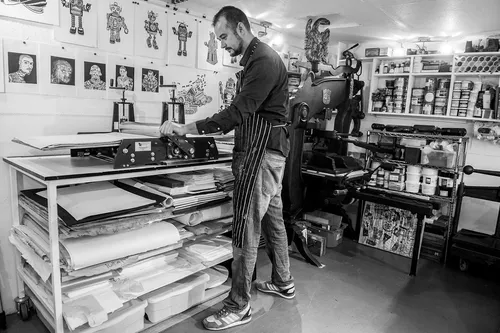
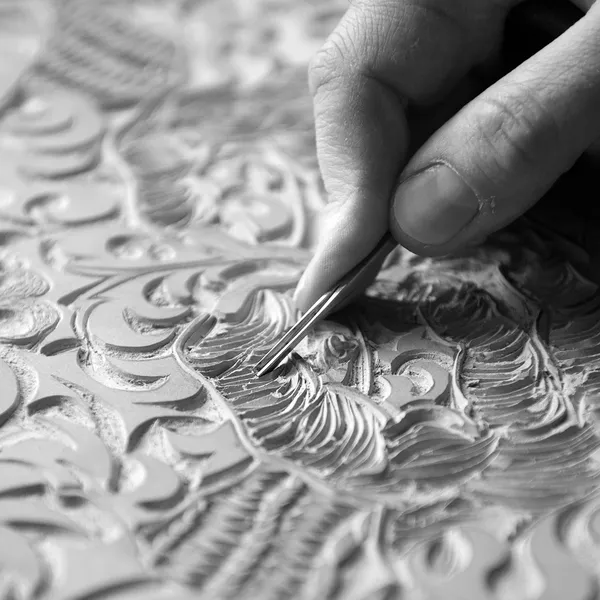
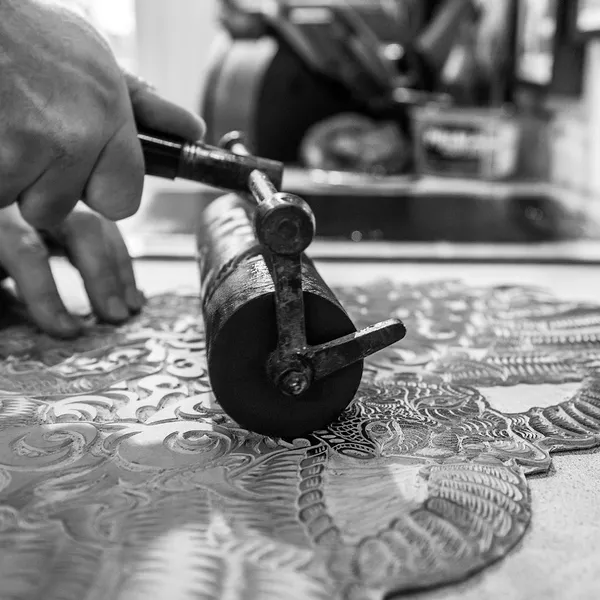
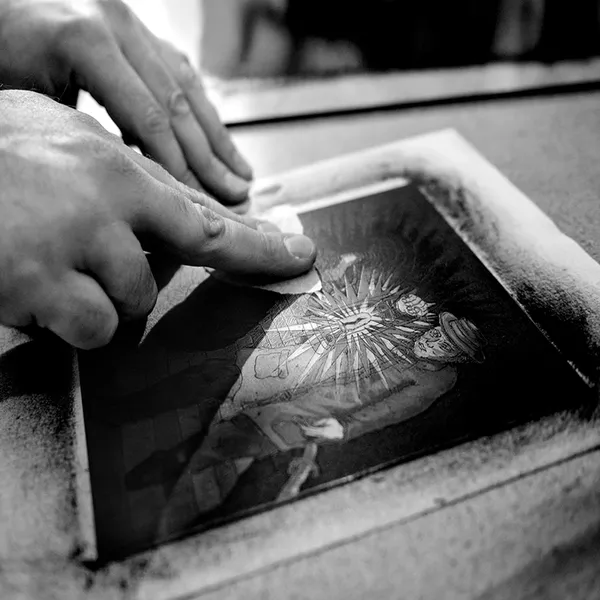
Studio
View
View
View
View
Artist's Statement
My work has a sense of humor within it even though sometimes I
make images which reflect the darker side of human nature. I am
interested in social and political issues and reflect these themes
within my work. My narrative images have hidden layers of
information within them which the viewer can find each time they
return to the work. The closer you are drawn into the image, the
more you understand about the characters and the lives they lead.
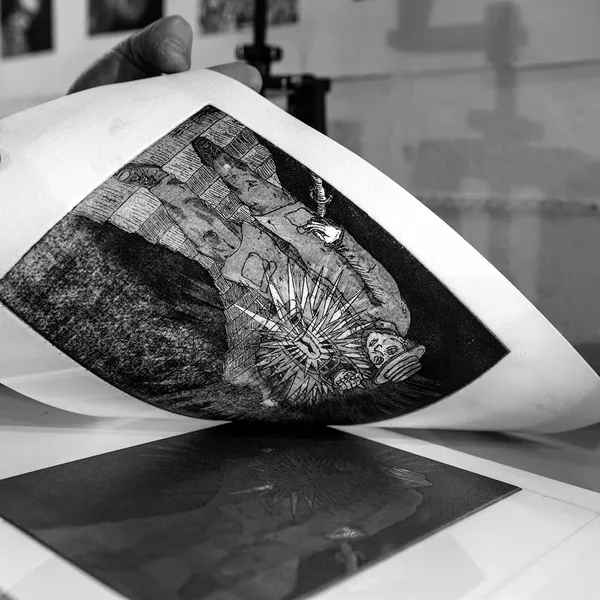
The process of drawing is fundamental for me. I enjoy how it
translates through different print processes and creates alternate
styles of work.
I see myself as a journeyman: travelling around, absorbing all the
variety of cultural differences and architectural styles when I
visit a new city, exploring people's lives and conditions in the
twenty first century. These observations are then reflected
throughout my work as a series of sequential narrative images.
I enjoy exploring new ways of making work through combining
different media together, working with the interactions and
juxtapositions of materials and techniques, which encourage fresh
viewpoints and outcomes.
Drawing is a powerful medium which allows me to push my ideas into
different directions and create the fantastic. There are no rules
to be followed: just pure experimentation and fun to be had.
Collaboration
Collaborating with Fernando Feijoo is always the most stimulating
challenge!
From initial bouncing of ideas based on an immense variety of
inspirations - from contemporary events, world calamities,
political shenanigans and corruptions, to literary or artistic
influences, and animated discussions.
Often it is just word play and sometimes misunderstandings which
are thought provoking and/or hilarious. Research follows. Drafts
are tentatively produced. Fragments are extracted, sketches made.
Talking and writing and drawing all at the same time. A structure
emerges. Then there can be a long process of determining the
layout and composition, the detailed honing of particular skills
in lino, or etching or whatever is right for this subject, and the
layers and layers of printmaking undertaken in the small hours.
Sometimes it is hours of reading through existing texts and trying
to find our angle. Sometimes it is an existing structure such as
an alphabet that is created on a theme. Often it is the joint
creation of a new or different style of word making and print
making.
The writer has to go for frequent walks to let the words move
around in the brain and be said aloud. The artist observes and
sketches, and draws the line in the lino or the plate. Two
processes merge into the final work. In most of our collaborations
my work as a writer is in the early stages and then it is all
handed over to the artist. Only a little tweaking is needed later.
We both delight in the sudden fizzes of getting something right
and share the greatest respect and appreciation of each other's
skills.
Review
We are now approaching the 3rd decade of the 21st century, living
in what not so many years ago was called 'the future'. There are,
to be certain, some things about our world that resemble the
visions of Science Fiction writers, but much of daily life is
still about people doing what they can to make a living in an
increasingly divided world. It is that world that is the source of
the inspiration and subject matter for the challenging,
entertaining, visceral and unique work of Fernando Feijoo. To
begin with, his art is extremely well made, technically flawless
but, unlike some artists in the international printmaking
community for whom technical perfection seems to be the primary
goal, it goes much further than that. The high degree of skill
that he has in his hands is inseparable from the originality and
acuteness of his observation of the urban world around him, as
well as his desire to ensure that his work should relate strongly
to the times in which we live. In his work he holds up a mirror to
the world around him and shows us its reflection. As with all
reflections there are sometimes distortions and exaggerations, but
these only serve to heighten the drama of his subject matter. The
world that is reflected is seldom a pretty place: it is by turns
perplexing, hard, comical, tragic, and melancholic, but his work
is always respectful of the people and situations it depicts.
Further than that it can be brutally honest in its portrayal of
parts of our world that are far from being perfect, and from which
many people turn away.
There are echoes in his work, as the artist gladly acknowledges,
of artists such as Hogarth and Goya, and also Daumier, Masereel
and Posada among others, all of whom used the techniques of
printmaking and its inherent reproducibility to comment on their
world. While their work did not by itself succeed in changing the
course of history, such artists did have a powerful effect on the
thinking of some of those who saw their work and that in its turn
led towards some improvement in the societies in which they lived.
In this sense Fernando Feijoo's work and approach makes him heir
to a long and honourable tradition of socially engaged artists.
Just as his antecedents made use of the opportunities and
materials available to them, so also does Feijoo. The difference
is that the media-rich world in which we live affords him a far
greater range of mediums, materials and means for sharing than
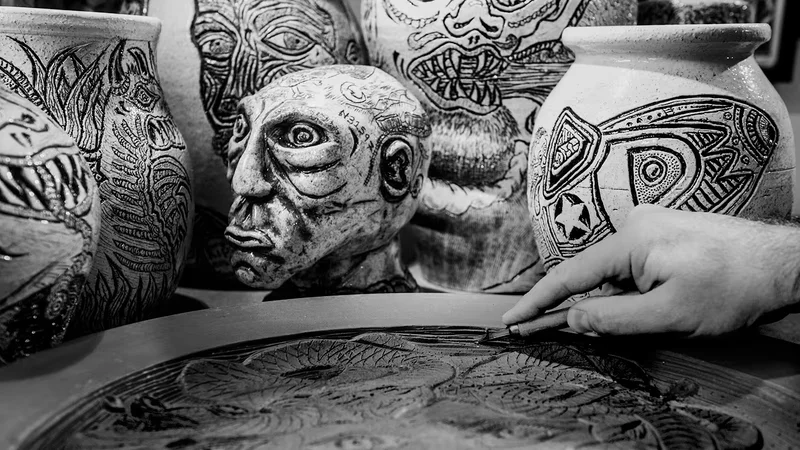
were ever available in the past. This artist works across many
artistic mediums, from drawing through painting and sculpture to
books and illustration, selecting not only the appropriate medium
(or mediums) for the expression of his ideas, but also the
materials with which to render them to the best advantage and in
his distinctive style.
One of the strong points in this artist's work is that much of it
is based on the ideas, sketches and references that he records in
his notebooks, one or more of which travels everywhere with him.
Many artists these days use a smartphone or perhaps a digital
camera to make a record of some of the things that have caught
their eye and which could be incorporated in a future work. Feijoo
prefers to use a sketchbook, a time-honoured process-rich means of
making connections. To have the privilege of seeing an artist's
sketchbooks within the context of an exhibition adds considerably
to the enjoyment of the work – it makes the connections visible.
Drawing has become under-rated in our tech-rich lives, but is
still a potent medium. This is evident in his sketchbooks, but
also in to richness of line in his prints, and in his other works.
They are compositionally complex, creating visions of an 'other'
world through which the viewer's eyes can wander, seeking out the
secrets or guessing at what is going on.
To pay due respect to Feijoo's work requires a sense of engagement
and complicity from the viewer, and the time spent is
well-rewarded. Many of his works are in stark black and white,
sometimes combining with great skill within the same image, areas
that appear to be in negative and others in positive, adding a
richness to the whole piece. His use of colour, when it happens,
is closer to comic book than limpid watercolour, and all the more
appropriate for that. In all of his works there are layers of
visual mastery, trickery even, that make the act of looking at
them both an adventure and an excitement, with an aftermath of
thought-provoking satisfaction.
Let's Connect
Ready to createsomething together?
Whether you're interested in commissioning a piece, acquiring
existing work, or simply want to discuss art — I'd love to hear from
you.